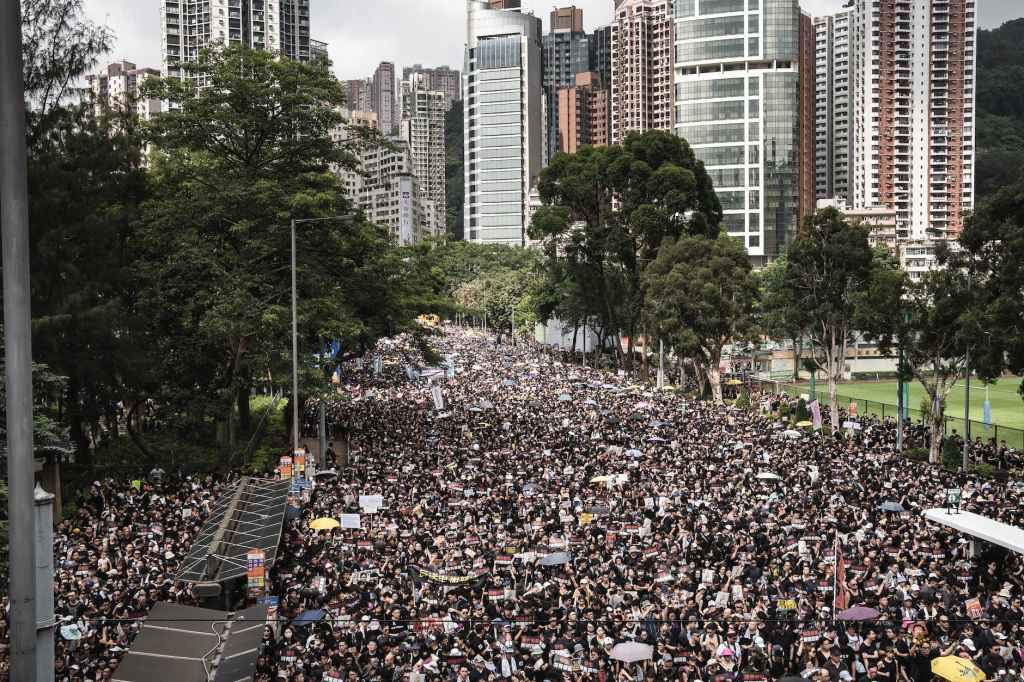
The umbrellas have been put away for the time being, but the arguments of where Hong Kong stands still have to be navigated. Jimmy Lai, the editor, founder and owner of Apple Daily is being charged under Hong Kong’s legislature with a whole plethora of charges, that range from conspiracy to commit foreign collusion to publishing seditious material.
Of course Jimmy Lai is not guilty, he and Apple did what any publisher would do and that is report the facts, but somehow – someone needs to be blamed for the mass protests that took Hong Kong onto a trajectory of freedom from the hated security laws that Premier Lam was bringing in. But the idea of sedition is not a new one, China has used this argument continuously since the founding of the Communist Party to get rid of those that did not agree with the Party officials arguments. These laws have come into the lexicon of the Hong Kong officials, and they use it with impunity; though voices such as Jimmy Lai only reported on the events taking place throughout Hong Kong three years ago, he is now a man imprisoned, by a set of laws that are hated.
The prosecutor Anthony Chau argued that “This case is about a radical political figure […] who conspired with others to bring hatred and stir up opposition to the government and the central authorities.” He also argues that Jimmy Lai colluded with other countries or “external elements to endanger national security.” Chau did not stop there, he argued that Lai was “the mastermind” who used his media business “as a platform to pursue his political agenda […] and orchestrated a conspiracy with democracy and freedom advocacy groups.”
The Hong Kong prosecutors office opened the case to include foreign national, who they accused of being agents that Mr Lai collaborated with. Benedict Rogers, named by the prosecutor is the chief executive of Hong Kong Watch, a UK charity. Rogers told the Guardian Newspaper that “The crime Mr Lai is accused of is talking with foreign politicians and activists, […] and engaging in journalism – which, as the publisher of a major publisher of a major newspaper in Hong Kong, ought to be regarded as entirely normal legitimate activity.”
Sarah Brook, Amnesty International’s Deputy Regional Director for China, said: “This case has been an attack on press freedom and freedom of expression from the start. […] He (Jimmy Lai) has already been arrested for his newspapers journalism, denied the right to bail and prevented from choosing his own lawyer. Now he face a sham trial presided over by a judge handpicked by Hong Kong’s Chief Executive.” […] It seems clear that Jimmy Lai and Apple Daily were targeted due to the newspapers criticism of the Chinese and Hong Kong governments.”
Lai is an extraordinary man and fighter, he has proven it personally and financially. He left mainland China at the age of twelve and in 1975, worked in sweatshops and raised enough money to buy a bankrupt garment factory to produce sweaters. He then founded Giordano’, an Asian retailer with more than 8,000 employees in 30 countries.
After the 1989 Tiananmen Square massacre, he became a critic of Beijing and left the retail business and founded Next Media and in 1995, he launched Apple Daily, which soon became Hong Kong’s second most popular paper.
On the 10th August 2020, Lai was arrested and charged with colluding with foreign forces – a crime under the new national security law. Later that morning, 200 national security officers raided Apple Daily and seized material and froze Lai’s HSBC account. Lai wrote from prison to his staff that “Freedom of speech is a dangerous job, please be careful not to take risks. Your own safety is important.” Lai also argues that Journalism is important, he wrote from prison that “A journalists responsibility [is] to uphold justice” and that “the era is falling apart before us, and it is time to stand tall.”
The World Association of News Publishers have awarded Apple Daily, their staff and the seven charged with numerous crimes, the Golden Pen of Freedom Award for standing up to the authorities and publishing accounts of the student and mass protest by residents of Hong Kong for standing up to the hated security law.
Chris Patten, the last British Governor of Hong Kong argues that the leadership of the CCP were terrified of the opening up of the world and one of the first things that Xi did was to bring about a document called Communique Number 9, which led to Hong Kong being seen as an existential threat to Chinese rule. Xi has created a narrative that has been characterised by suppressing free voices, especially in Hong Kong through the new law that was created in Beijing and rubber stamped by the Hong Kong legislature without even a discussion, or being seen.
Jimmy Lai is now under the rule of Chinese law and can be extradited from Hong Kong to mainland China because of this law, he can also be held for twenty years and treated in very much the same way as Lei Pen, who was seen as the leader of the Tiannamen demonstrations. Constantly held by the Chinese authorities and only released weeks before he died of cancer. But Jimmy Lai, who has the wealth to challenge Chinese rule from a home in another country believes that this threat from the Chinese authorities is very much a battle that must be fought in Hong Kong.
In many ways it was the childhood of Jimmy Lai that is writing the final narrative of this amazing man’s life, from a family of wealthy merchants in China, to a desperately poor childhood when everything was taken away by the CCP, and begging for odd jobs to feed himself and his family. It is his faith in the Hong Kong that enabled him to be ambitious and find wealth that has led to Jimmy Lai fighting a system that is unfair, undemocratic and challenges the agreement that Britain had with China at the handover of Hong Kong in 1990. He see’s himself as a child fighting for scraps of food and trying to make a living in China before escaping to Hong Kong, and that that this is a fight that he must make and, which is very much part of his DNA to fight an oppressor in his beloved Hong Kong.
 Current Affairs
Leave a comment