
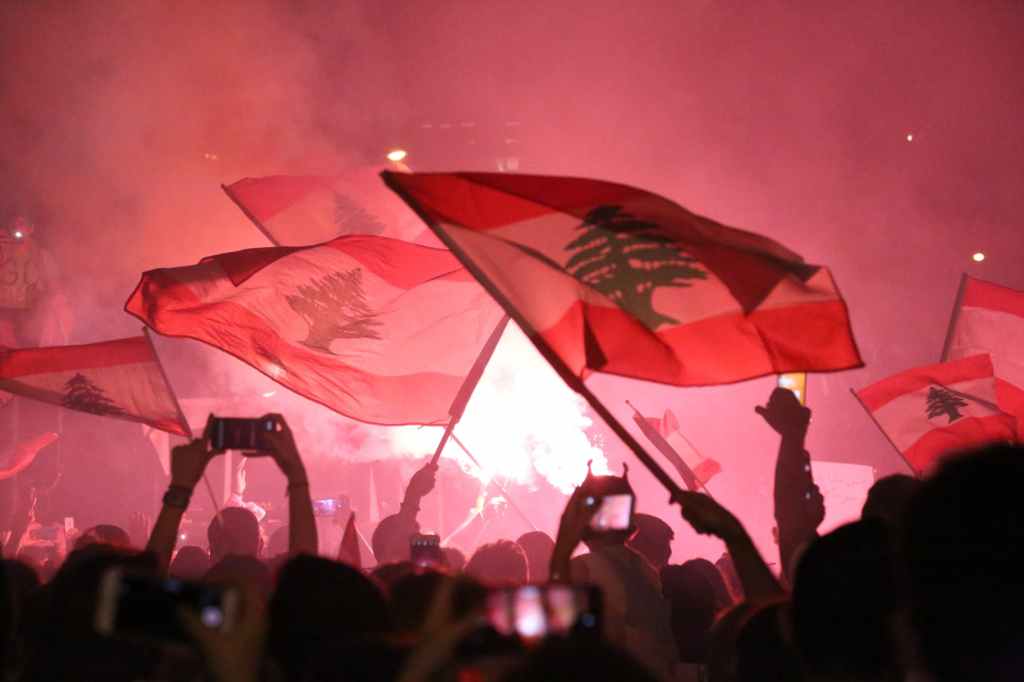
Politics in Lebanon is normally a dull affair where the same names and parties dominate arguments that morph into a singular contention of – what’s in it for me -. But since the uprising of October 2019, where hundreds and thousands of Lebanese took to the streets to demand political change, there has not been a stable government. Arguments of how the country should be split between the politicians dominates the political canon, such as, who should be president, the prime minister or even the leader of parliament, which are all contentious questions.
But since the demonstrations the old guard have held out through the Covid 19 pandemic, an explosion at the port in Beirut and hyperinflation that has impoverished the majority of Lebanese. Since 2019, the young, talented and those with contacts have emigrated, got work abroad, or are just too poor to escape the country.
The failure of the October 2019 uprising is that the government has been paralysed by infighting among the sectarian elite, who have destroyed the ability of those that care to find answers to all the problems that the Lebanese face. Even when a government has been agreed, that governments ability to negotiate with the IMF and manage the economy has been undermined by powerful interests. After years of corrupt government and a central bank that has bankrupted the economy, the question of how you save the country has been juxtaposed by the question of how to survive hyper-inflation.
Early in the economic crisis, donor countries conditioned a rescue package of the insolvent state and financial sector. Hassan Diab, tried to reach a preliminary agreement with the International Monetary Fund, but in the spring of 2020, a coalition of politicians and those with powerful financial interests sabotaged the negotiations.
The elections in 2022, seemed like an opportunity for the Lebanese to elect the remnants of the leadership of 2019 mass demonstrations. The opposition to the old guard never materialised, they were not necessarily going to assume power, nor were they representative of the Lebanese, because the country’s regime is determined by sectarian argument, but there was an opportunity to gain a few seats, which would place pressure on the old guard and maybe bring about some change.
According to Sam Hellier, writing on the Century Foundation website, “Lebanese party politics have reverted to familiar tropes: partisan attempts to gain relative advantage, political media gossip and speculation about great power intrigues.” But as a whole there has been very little governance since the Port explosion, and since the elections in 2022, there has been so much infighting that there has not been a government with any substance.
Pressure is being placed by international donors for reforms to be put in place, countries such as Saudi Arabia argue that there cannot be any investments in an economy without reforms. But if Lebanon was to meet the demands of investors or donors, such as audits of state finances, it would lead to questions of the murky world of political patronage, where politicians have divided the state resources to maintain their standing among their community. It is complicated, but to argue that this is corruption, which could be stopped does not actually place a line of fault on any one party, sectarian group or politician, as each party, politician or group would blame the other party, politician or sectarian group.
With Lebanon’s establishment still empowered after the election, there is very little chance that there will be any change, whatever the donor countries demand. There have been some donations, but the donor countries are concentrating their investments on humanitarian work and also the army to keep the status quo. But the worry is that the politicians will continue with the sectarian argument, as the communities have a sense of insecurity due to economic woes, and with an apparatus of patronage that the politicians have used to extend their control.
In June 2021, a coalition of new parties did win three quarters of the seats in elections to the Order of Engineers and Architects. But this success did not carry through to the 2022 national elections, so the manipulation of the system still continues as the old guard have the means to continue corrupting the system. But there is hope that change is taking place, even though communities are impoverished and dependent on the levels of patronage, just to get by. There is hope that with the wealth being tied up with the debt, this system of patronage will come to a natural conclusion, but ultimately this is dependent on those who feel strongly that there can be change.
But there is hope that there can be change in Lebanon, the lawmakers have nominated Jihad Azour an International Monetary Fund regional director and former minister, for president. After weeks of negotiations, 32 Legislators endorsed Azour, who is “not considered provocative by any political factor in the country,” however Hassan Fadlallah a Hezbollah lawmaker, argued that he was a “candidate of confrontation” and that “it would be a waste of time to elect him.”
It is the bitterness of the parliamentarians who have tried to elect a candidate eleven times that has stopped there being a government. Hezbollah to a degree has been to blame, their candidate is a pro-Syrian candidate named Sleiman Frangieh, who has very little opportunity, even so, he would be contentious.
If Lebanon is to get out of the trouble that it is in, it needs change right through the system of government, where government is controlled by the checks and balances that happen world wide, would enable the Lebanese to negotiate with the IMF and find terms that can be lived with and ultimately lead to a loan that picks the poorest up from the destitution caused by hyperinflation and poor governance that is corrupt in its inception.
 Current Affairs
Leave a comment