
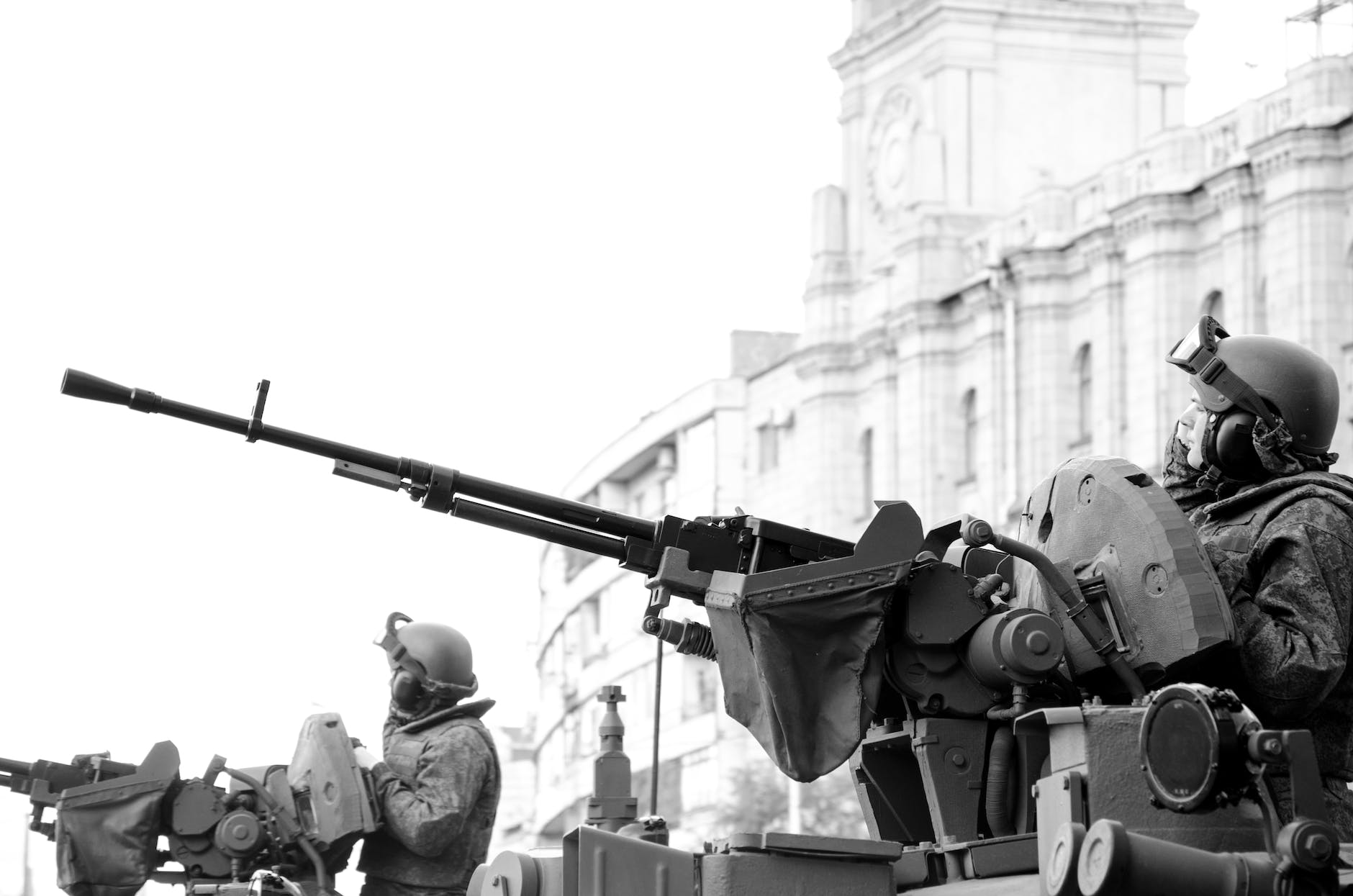
The message from Ukraine was thank you for all your help, thank you for the artillery, thank you for the missile defence systems, but we need tanks. We are fighting not just for Ukraine, but Europe as well. We are fighting to defend the free world from Putin, President Zelensky argued in a speech to the 50 countries meeting at Ramstein airbase to discuss the Ukraine conflict.
Simple words, but there is just one question, will the German’s allow the supply of Panzer Leopard II, “not without American tanks,” seems to be the message from Berlin. Other options are that tanks are supplied by countries such as Poland, Latvia, Lithuania or elsewhere there are Leopard IIs. But the problem is that these countries have to ask for permission from the German government before they can be sent to Ukraine to bolster the defence force. So the question is why won’t Germany move. “We won’t move without the American’s supplying the Abrams.” America’s answer to this is simple, the Abrams are not suited to the war in Ukraine, they run on jet fuel according to the US Defence Department, however the engines are supplied by Honeywell, who claim that they run on petrol and diesel also.
But are there other reasons that the American’s don’t want the tank on the battlefield of Ukraine, other arguments that have come thick and fast from the Department of Defence is that the technology could not withstand the weather in Ukraine, they are not suited to the environment, but one of the main reasons maybe that they do less than one mile per gallon.
Like all tanks in the West, the technology is 1980s architecture, the technology updates are from the 1990s, but as a whole they are meant to be superior to the Russian tanks. What are the other reasons that the United States would be worried about the supply of tanks to Ukraine. It could be said that the United States is the superior supplier of weapons to Ukraine, it has to date supplied $27 billion in weapons to the Ukrainians and it is the leading supplier out of all the NATO countries. This argument is an argument of whether Putin’s assertion that Russia is fighting NATO, but especially America, who as the leading supplier of defence equipment both monetarily and in weapons to Ukraine, means that this war is actually a conflict between the United States and Russia, which would underpin Putin’s argument that Russia is in direct conflict with NATO but also America.
By not sending tanks to Ukraine, Germany is arguing that there would be an escalation to the conflict. They argue that it may force Russia’s hand and lead to attacks on German factories supplying weaponry to Ukraine, and could lead to further conflict, which escalates into a nuclear war. But to date the Russian’s have bluffed, but could the bluff turn into a reality if they lose in Ukraine, that seems to be the opinion of Chancellor Olaf Schultz. He views that an escalation in the war and an outright loss by the Russians could lead to a widening of the conflict.
Britain and France are the only countries in Europe that have made their intentions clear and are in the process of sending tanks to the conflict zone. Neither Britain or France are held by Germany’s right to refuse sending this type of military architecture, because they are manufacturers of the tanks. However, Ukraine needs upwards of three hundred tanks and Britain and France’s contribution is not nearly enough. There are other concerns, the head of the British military argued this week that they were degrading their resources and that the Army needed new weaponry quickly to counter further degradation of the military architecture, especially if the war escalates further into a direct conflict between NATO and Russia.
For all the bluffs that Putin has made, the most serious is that the war could escalate. Whether that is an armed conflict or nuclear is unclear. But Germany seems to believe that there could be an escalation if it does not move carefully. But there are other arguments concerning how this war will progress if Putin does not get his way. These concerns can be found in his belief that the West is inherently weak, it is determined by arguments that it is inherently weakened by its values and is not ready to fight a war.
According to Professor David Lewis writing in the RUSI, Putin’s philosophy is that the West has been weakened by its adherence to Western liberalism and that the West is in terminal decline. Putin’s neo-conservative ideology is still in formation, but as a whole he views Russia as a superior power both ethnically and philosophically. Putin believes in Russian exceptionalism, meaning that Russian’s are the chosen people and that its thousand year history de-marks Russian’s as a world power.
The second point that Professor Lewis makes is that Putin is determined by Classic Imperialist sentiment, which denies the sovereignty of Russia’s neighbours, he views Russia’s argument historically and openly talks about restoring Russian unity, which means a redrawing of Russia to before the collapse of the Soviet Union. Professor Lewis argues that Putin has “managed to mix [his] neo imperialist vision with an anti-colonial discourse. Putin advocates an emancipatory anti-colonial movement against unipolar hegemony.”
The final argument of Professor Lewis is of traditional values.Putin views the west of attacking these traditional values and that gender is among many of the attributes that the West uses to corrupt the traditional values of Russia and elsewhere. He accuses “the dictatorship of the Western elites of plotting the overthrow of faith and traditional values and of practising pure Satanism.
Of course Putin is a dangerous man, but is the argument about the tanks determined by Putin’s philosophical beliefs, historical perspective and so called traditional values, the reason that Germany and the United States are hesitant in over supplying the Ukrainians with the weapons that they need. The question has to be whether it is a question of containing Putin or challenging him on the battlefield through the Ukrainians. But ultimately it becomes a question of accepting that Putin’s ideology is escalatory in its inception and that the next conflict could be in Latvia, Lithuania or Estonia, and that directly affects NATO. So the question of the tanks is arbitrary as the philosophical arguments that Putin believes challenges whether the West reacts to Russia now, rather than in the future.
 Current Affairs
Leave a comment